Author: kscory (Page 1 of 3)

Reflection to Jo Chrona

In yesterday’s class, we read an article titled If Not Here, Then Where? by Jo Chrona, which is found in her book Wayi Wah! Indigenous Pedagogies: An Act for Reconciliation and Anti-Racism Education. https://luudisk.com/2022/04/25/if-not-here-then-where/

What Happened?

Jo Chrona speaks about her experience being apart of building the new British Columbia K-12 ELA curriculum. She recalls being asked, “Why are Indigenous content and perspectives necessary to teach in a classroom with no Indigenous learners?” (Chrona, 2022). Chrona then explains the importance of mandating Indigenous content and perspectives in all classroom across British Columbia.


“When we address the lack of knowledge and understanding about communities, cultures, histories, and rights of Indigenous peoples in Canada, we will have an education system that is responsive to First Nations, Inuit, and Métis learners”.

jO cHRONA, 2022

So What?

In Shelly Moore’s video People are NOT Supports, she discusses how “People can be supportive but are not supports. Supports are tools that increase independence” (Moore, 2025). What stood out to me was how this connects to Truth and Reconciliation in Canada.

Looking at UNESCO, reconciliation is “based on the acknowledgement of past injustice, the acceptance of responsibility and steps towards (re-)building trust. It is often understood as going beyond formal conflict resolution to changing the nature of the relationship between the conflicting parties as part of a long-term communal relationship-(re-)building process” (UNESCO).

Reconciliation requires those who caused harm to acknowledge their actions and take responsibility and to rebuild the trust. However, what we continue to see today in 2026 is that Indigenous People’s and groups doing most of the hard work toward reconciliation. This connects back to Shelly Moore’s point that people are not supports – strategies are. For reconciliation to progress, Canada must stop relying on the Indigenous People’s of Canada to carry the burden of reconciliation and instead take proactive steps (strategies) towards rebuilding trust for a future in reconciliation.

People are Not Supports

How Does Jo Chrona Resonate With Me?

I resonate with Jo Chrona’s post because I remember being in school for a dental assisting program and thinking, “The Indigenous education I am receiving does not prepare me for working in this community.” That was the truth. My peers and I were unprepared to understand or respond to the traumas surrounding dental care for anyone in our community.

Had the program included discussions about the trauma specific to Indigenous People’s in Canada to dental care, we would have been better equipped to respond effectively to everyday anxiety in the dental office.

With all being said that is why we competency #6 Practise respect for all learners from all cultures, including, specifically, Indigenous learners. Integrating Indigenous ways of knowing, doing and thinking in the classroom are not only mandated by the British Columbia curriculum but also a mindset we are authentically learning when becoming teachers in British Columbia.

Comparing Thinking Models

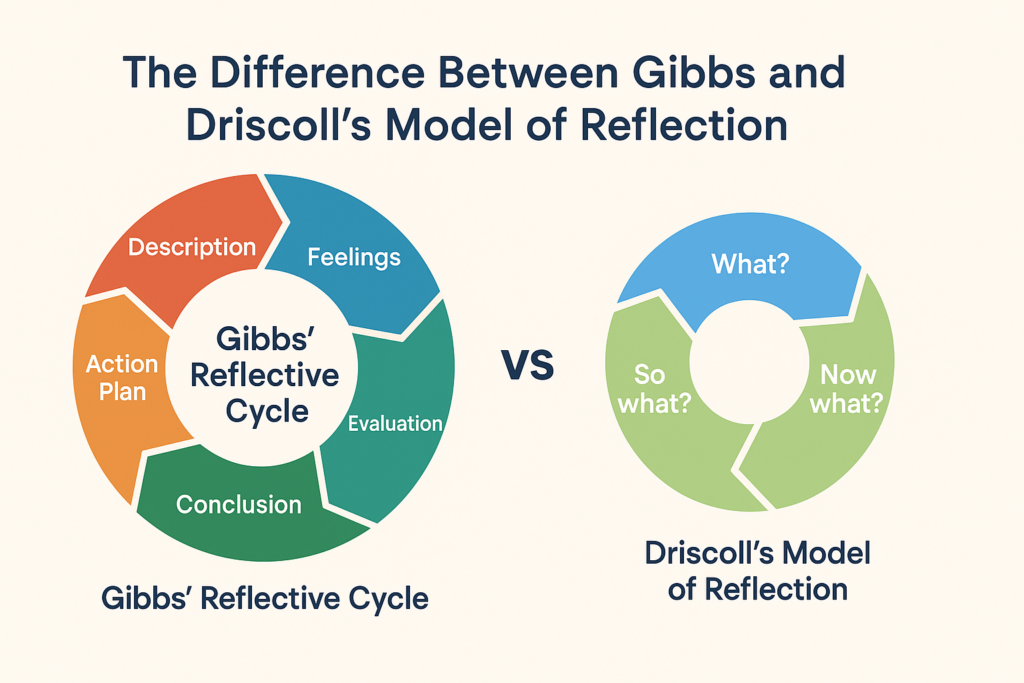
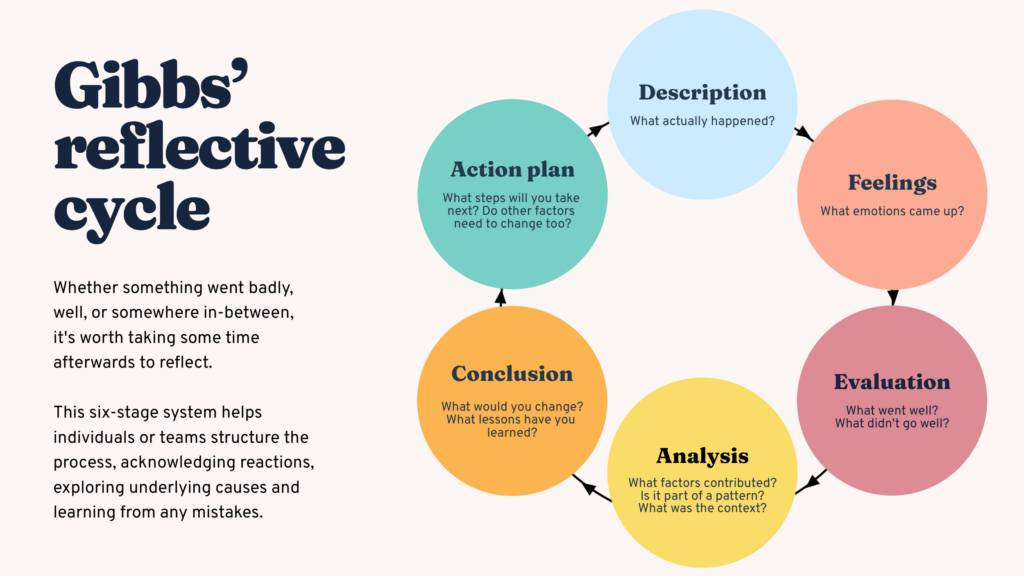
Gibb’s Reflective Model

Gibbs is a model we are familiar with in the program. It is a six-step model to promote critical thinking and a deeper analysis of events. Hopefully, after completing the six steps of reflection, you can learn from what happened and improve for next time! Even when you think you nailed a lesson, you should still take the time to stop and reflect on the positive. Over the past few years, I have practiced reflecting using the Gibbs reflective cycle a few times, and I find the trickiest part is identifying the feelings I experience in an event, but I have noticed that the more I reflect, the easier it becomes. However, I enjoy that the reflection is similar to a journal entry and a step-by-step cycle.

Driscoll’s Model of Reflection

Driscoll’s model of reflection is again a model used to reflect on a situation and decide what comes next. It is a three-step model that also works in a cyclical fashion, such as the Gibbs model. However, Driscoll’s reflective cycle is simpler and more straightforward that Gibb’s.

When to Use Which Reflective cycle?

Though both reflective cycles include thinking about the event, what happened and what will come next, both cycles have a time and place. Gibbs offers a deeper analysis of an event and can be used as a journal format or a paper. Whereas Driscoll’s is more applicable to day-to-day reflection because it has fewer steps and is more time-efficient. However, using Driscoll’s reflective cycle can often leave out details such as emotions you felt during an event.

My Turn to Reflect!

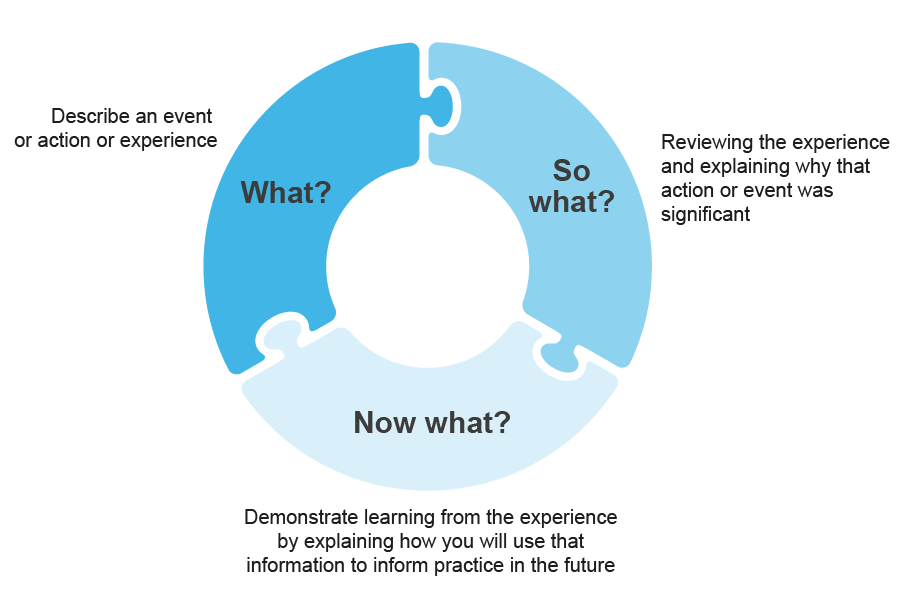
I am using Driscoll’s model of reflection to reflect on a lesson I recently taught.

1. Experience

I worked with a partner to create a music lesson for a local grade 5/6 class. We prepared a beautiful lesson with multiple modifications and asked for feedback on the lesson before we taught it. We showed up to the class prepared with all of our materials (basketballs, pencils, whiteboards and paper), but at some moments we did not have all of the students’ engagement.

2. So What?

This moment was significant because we planned our lesson to be interactive and hands-on the entire time, hoping that would result in high levels of student engagement. However, after discussing with the teacher of the class, she gave us some feedback for next time, such as taking more time to model activities even though it may seem obvious that a grade 6 student would know how to throw a basketball and explained that when students do not know what to do, they often will not even try.

3. Now What?

Luckily, I received honest feedback from the teacher, so I have a clear path for next time. Next time, I am going to leave more time to model my activities, which I needed as a reminder, so I am very thankful for her feedback. I will also create visuals for next time because some students could have benefited from the visual reminder.

Note* All images have been hyperlinked for more information and photo citation.

VR: The Wolves In The Walls

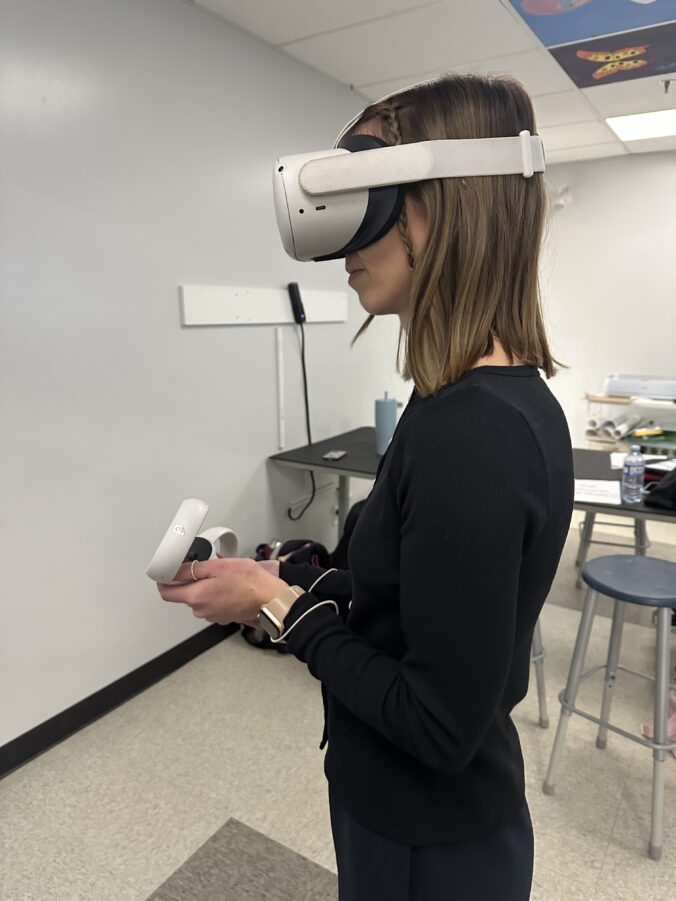
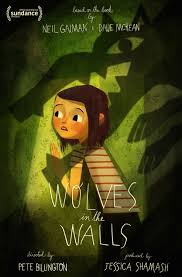
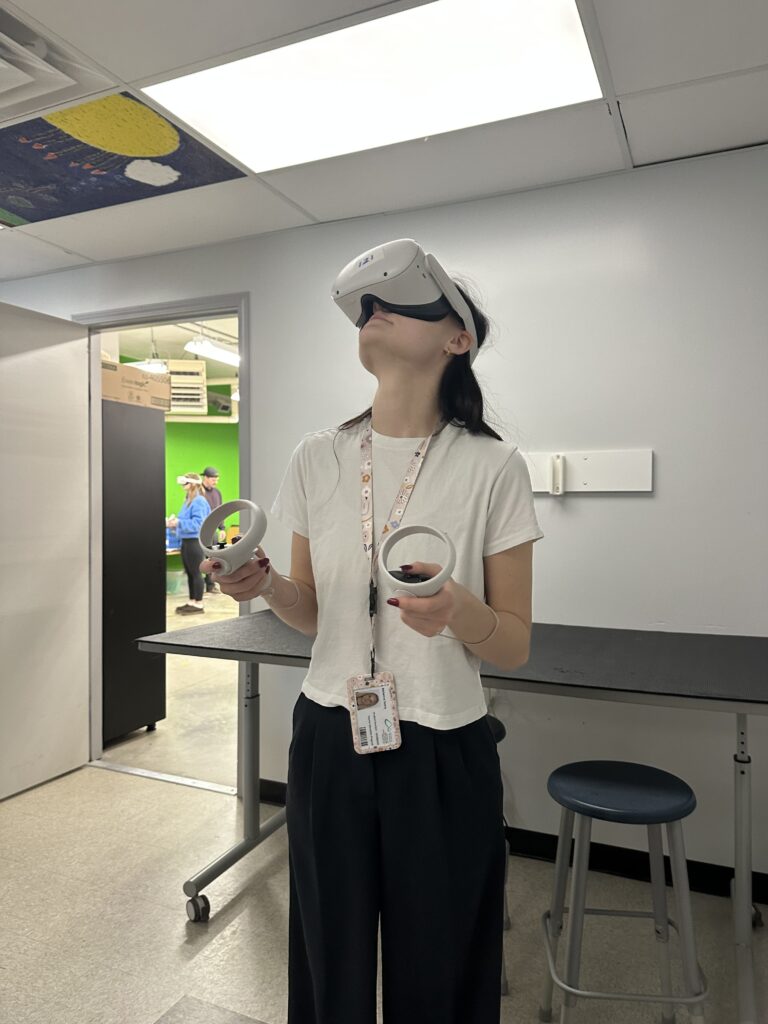
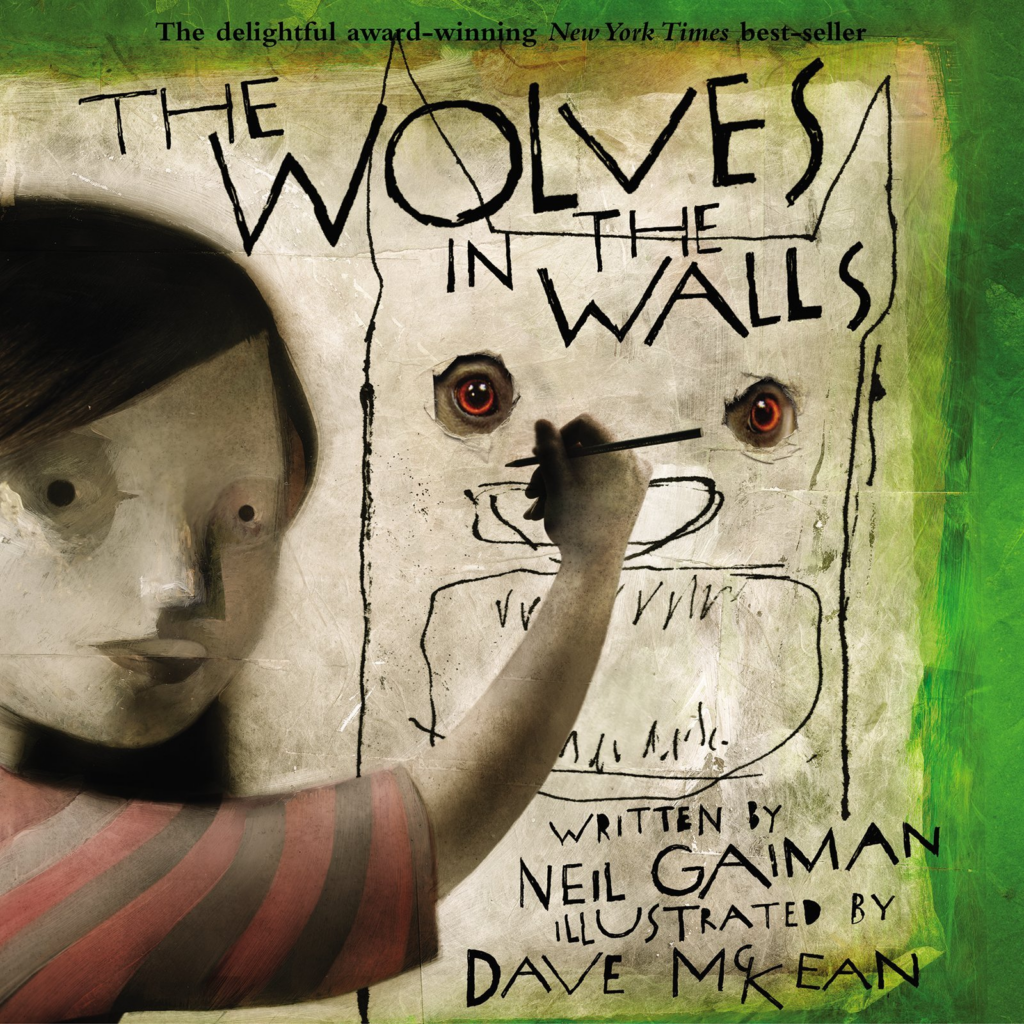
I recently had an amazing opportunity to use virtual reality technology with a local elementary class. The opportunity was led by my instructor and our district’s transformative learning teacher from the design lab. Before the session with the students, we practiced using the virtual reality headsets and went through the story The Wolves In The Walls by Neil Gaiman.

I have hyperlinked the book cover with a book summary!


Last year, I created a drama lesson plan using the book The Wolves In The Walls, so I was familiar with the book. However, the opportunity to be immersed in the story using virtual reality made the story more intense and a little scarier. After practicing using the virtual reality goggles and controls, we took the experience into a classroom the following day. We started the class by having students break into small groups and read the picture book with teacher candidates. After, because our design lab has only 11 Virtual reality headsets, we also had booklets with literacy activities for the students to do while waiting for their chance to use the virtual reality headsets.

The students really enjoyed using virtual reality and most students had prior experience using the headsets. However, the stickiest part was fitting the headsets to each student’s head. If the goggles are a little too loose, it can be blurry, but if the headset is too tight, it can cause discomfort and headaches. When I use virtual reality in my future classroom, I will be sure to have multiple adults in the room to help fit the headsets because it is not the quickest task.

My favourite part of the experience was casting the headsets to an iPad screen to be able to see what the students were doing. This was not only helpful to be able to jump in and guide students with any help, but also allowed other students to watch and listen to the story while waiting for their chance to use the virtual reality headsets.

Connection to Curriculum

The Wolves in the Walls was not a read-along; however is was an interactive reading experience that aligns with the British Columbia curriculum under the English Language Arts and Applied Design, Skills, and Technologies curriculum.

Virtual reality supports student literacy and literacy engagement within texts. Not only did the student have the opportunity to listen to the physical book being read to them, but they also had the opportunity to be part of the book using virtual reality, and as seen in the In-situ experiences, the kids loved it! The students I worked with had better recall of what happened in the book than any other reading experience I have had thus far. Though not asked, I am positive the students would also be able to share the plot of the story, including climax, main characters, any character development and any other deeper thinking questions because of their engagement.

The British Columbia curriculum also includes competencies surrounding digital tools to increase student learning. Students not only had the opportunity to use the virtual reality headsets in a safe environment where they were able to explore how to use virtual reality safely, but also discover a new way to learn; that may work better for them than traditional learning styles. These days, many students watch gaming videos during their personal time, and it is important to bring students’ hobbies into the classroom, and virtual reality is a great way to blend students’ interests with the curriculum!

Read Alouds

To Start…

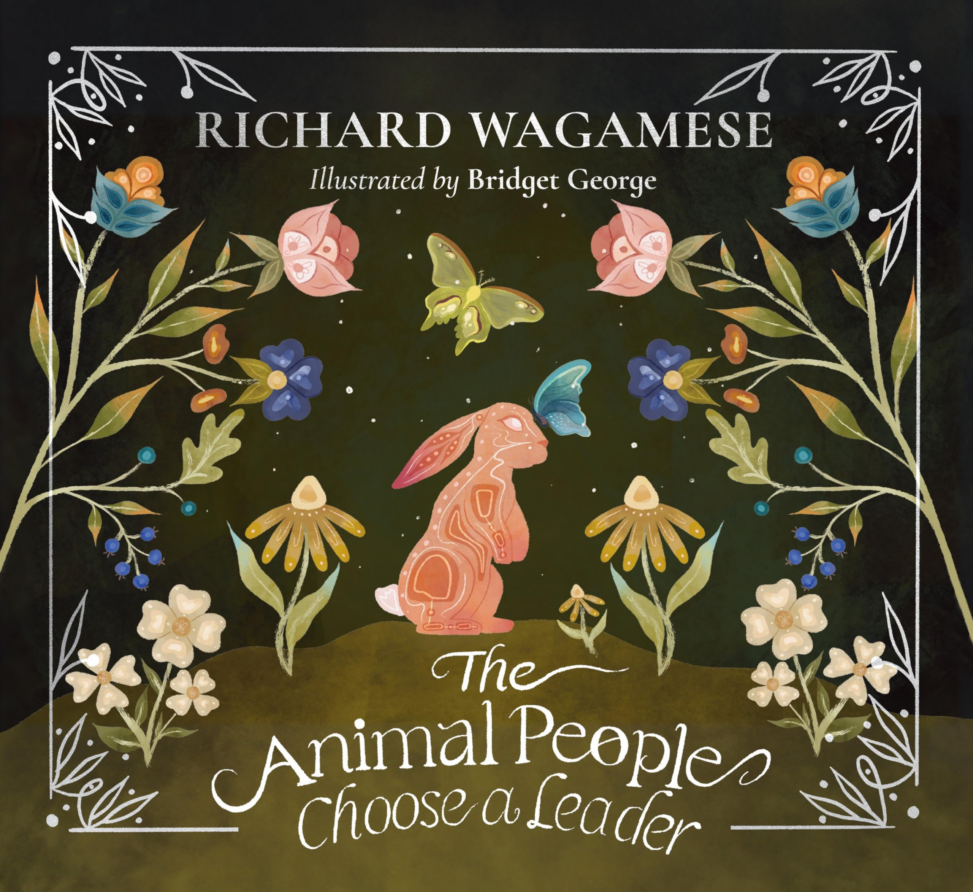
I recently had the opportunity to spend 3 sessions over 3 weeks with a local elementary class to practice my read-aloud skills. I started by reading Read Alouds For All Learners by Molly Ness to understand how to incorporate read alouds into a classroom properly. After deciding to read the book The Animal People Choose a Leader by Richard Wagamese, and illustrated by Bridget George. An intermediate picture book about Waabooz the rabbit, showing what a leader looks like during a race the animal people hold to decide their new leader. Waabooz was named leader after the race, not because she won the race, but because the animal people felt she was the best fit because of her caring traits. I then planned 3 activities for the students at 3 different stopping points with my partner Ryan.

The second choice for a picture book was The Inquisitive Raven by Richard Wagamese.

Ryan and I planned our activities using a planning template from Molly Ness. See the template in the link below.

Class #1

For the first class, we started by reading the first section of The Animal People Choose a Leader by Richard Wagamese, then followed with a drama activity. We grouped the students into groups of 4-5 and had them create a Tableau (a frozen picture) in which each student represented an animal in the book getting ready for the race. Each group was given a sticky note to write down how each animal felt in the moments leading up to the race. Each group presented their tableau and shared with the class what they wrote on their sticky notes. Then we ended the class with a group discussion. The class really enjoyed the drama activity; however, it was difficult to create groups that worked well with each other without knowing the class. For next time, I would book out a larger space, like the gym or go outside to give students more room and create groups that work better for the students.

Class #2

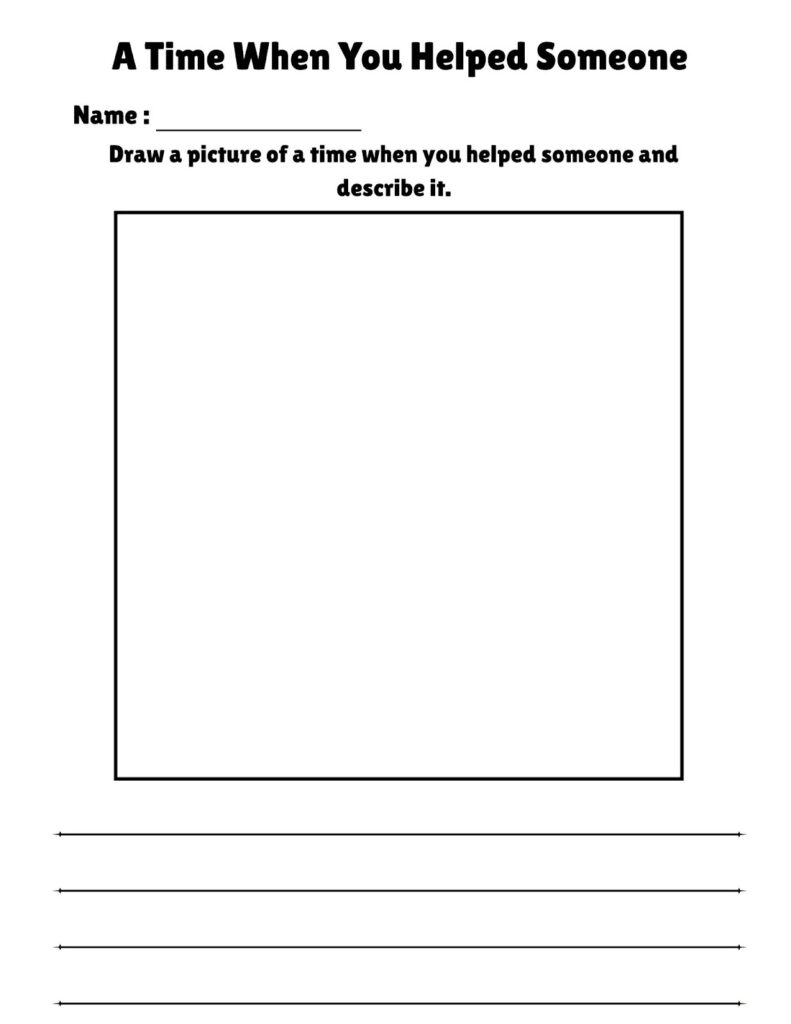
For the second class, we started by reviewing what had happened last time in the book in a popcorn-style class discussion. Then, we continued reading until the second stopping point. After, we had a discussion about Waabooz helping the other animals in the race and asked students to think-pair-share about a time when they helped someone. Then, we handed out a worksheet where students were asked to draw and write about that time. At the end of the class, we opened the floor to anyone who wanted to share. The writing prompt is designed to be on the easier end. Next time, I would create a more challenging activity to prevent the early finishers from finishing or have another activity ready to go for them. However, the class enjoyed colouring and sharing their drawings with their classmates.

Class #3

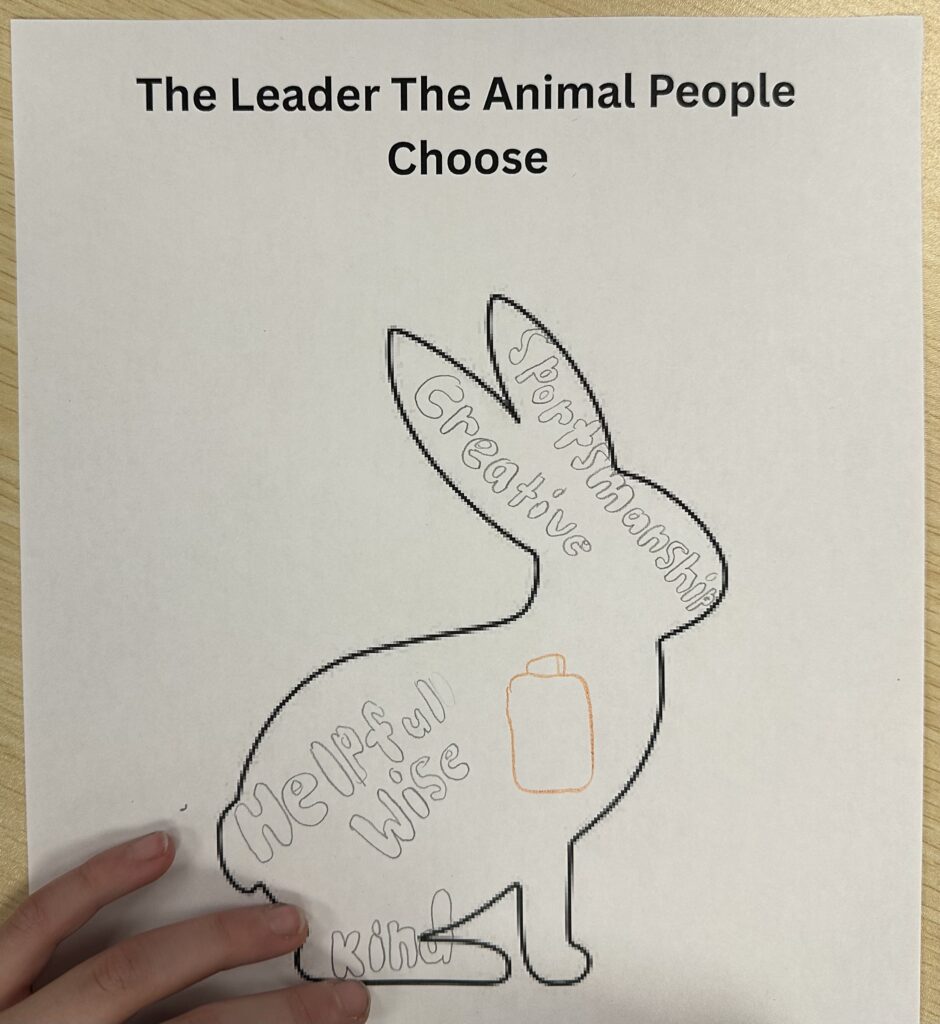
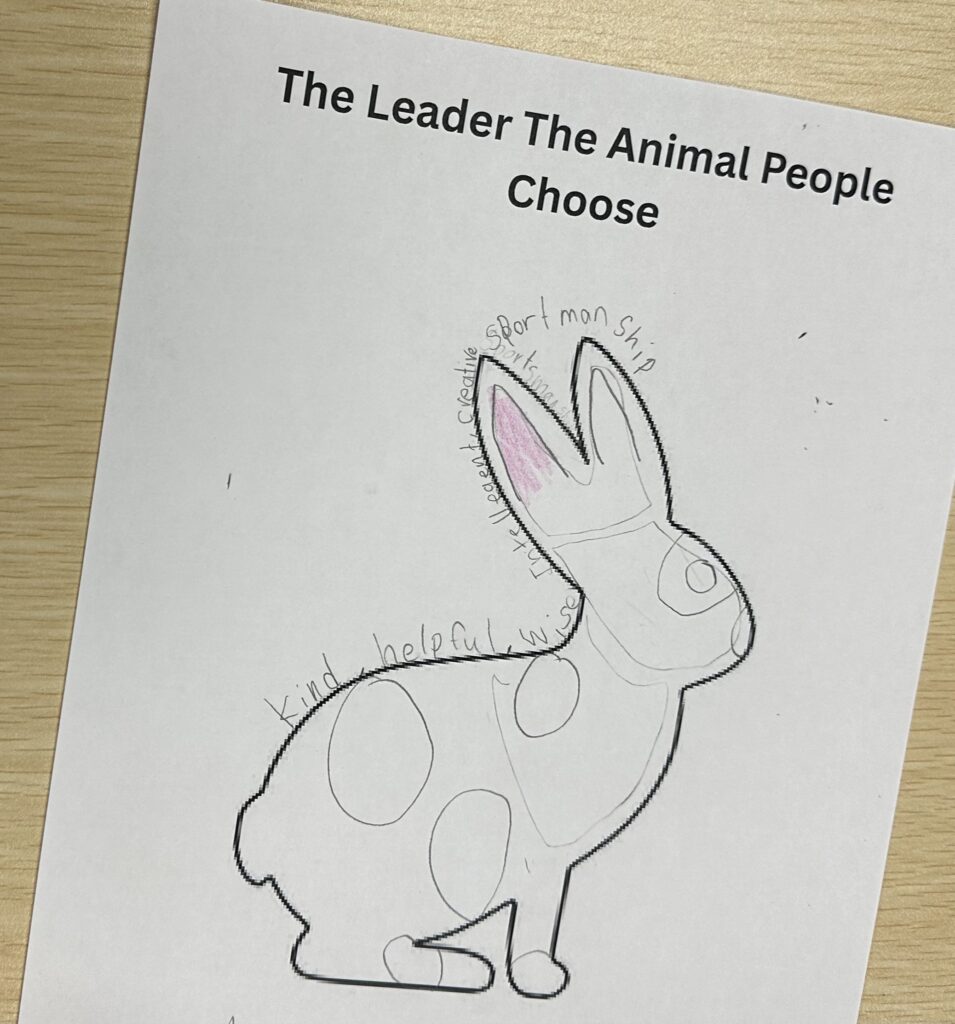
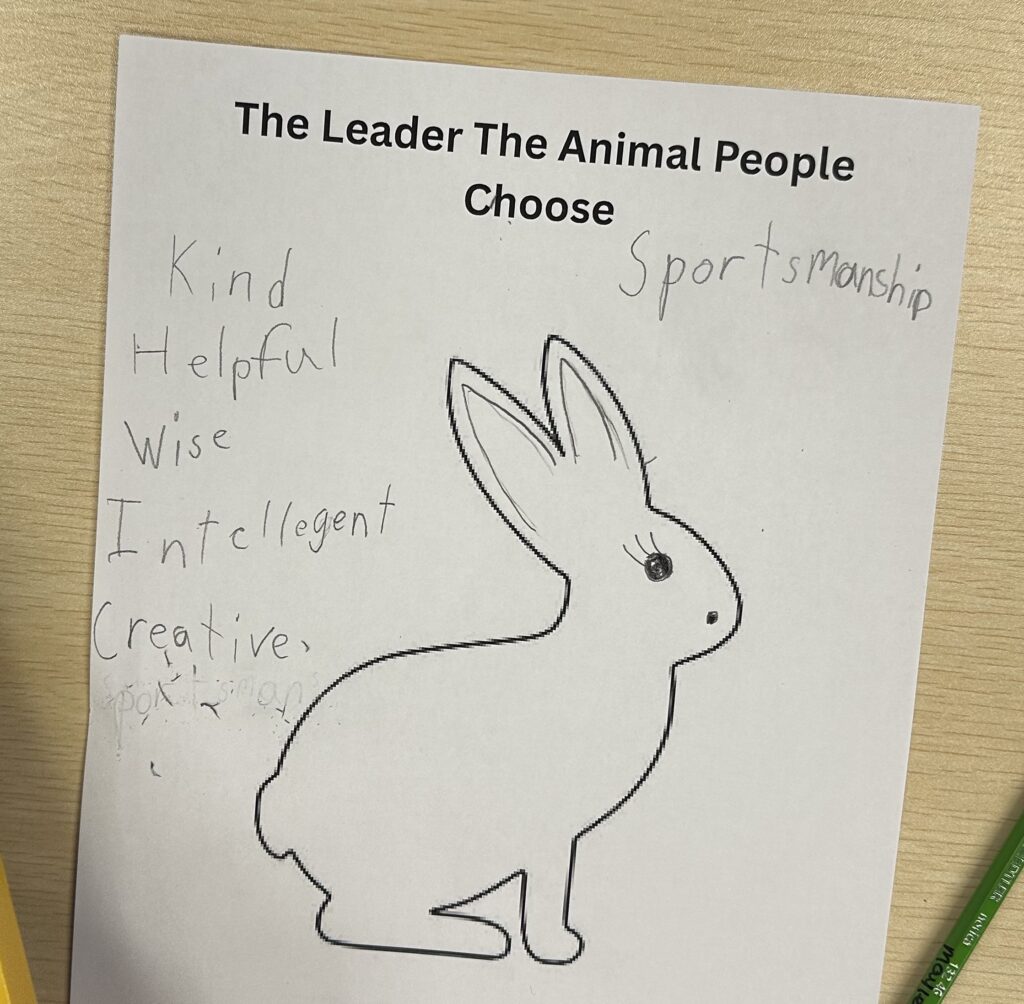
For the third class, we again started by reviewing what happened in the book previously. Then, we finished reading the book. After, we gathered all of the students and made a circle. We then played a spider web activity using yarn to demonstrate how each person has a role in a community, and followed with a class discussion. After, we gave the students a rabbit handout where the students wrote characteristics of Waabooz, who was named the leader of the animal people. In the future, I would plan for extra time because the students really enjoyed the spider web activity and wished to play it a second time.

AHA / Wonder Journal #2

Discovering a New Plant!

Note: This activity was taken and adapted from Judi Poole, 2026.

Starting in Kindergarten, students start learning about plants, both local and global. The curriculum starts by teaching little ones the basic needs of a plant and the types they may see in their community. And with each grade level, the biology of plants deepens until high school, where students learn advanced plant anatomy and plant cycles.

Not only do plants connect with all grade levels of the British Columbia curriculum, but plants are deeply connected to Indigenous People’s way of doing and knowing. There are many books teachers can use to bring local plants and Indigneous People’s knowledge into classrooms.

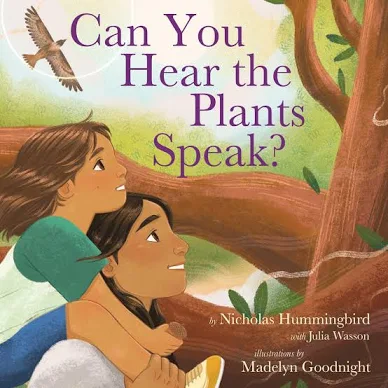
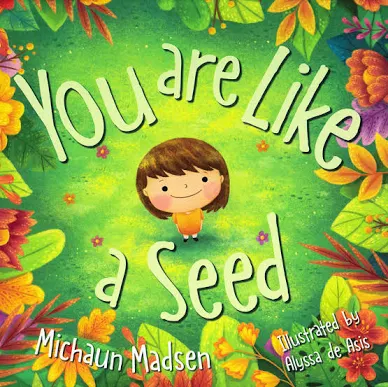
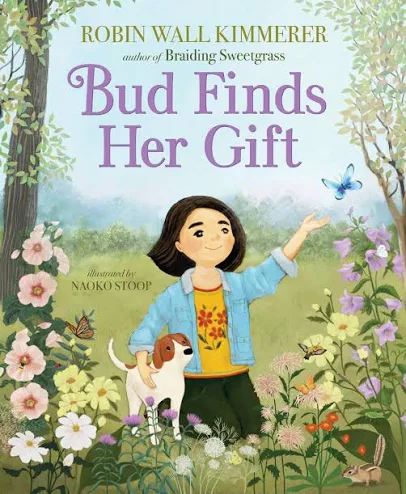
An activity introduced to me by Judi Poole that I really enjoyed is called You Have Discovered a New Plant! The activity is simple and fun. Start by reading a book to students that involves plants and flowers with some identity piece. Some examples I like are…

Images are hyperlinked.

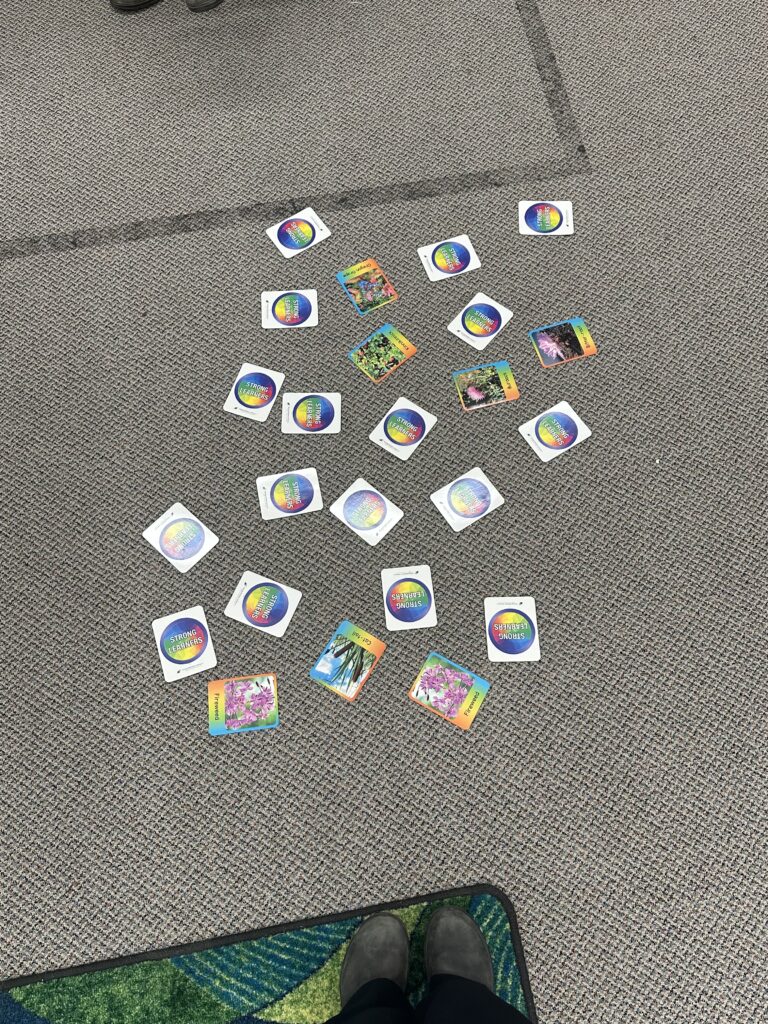
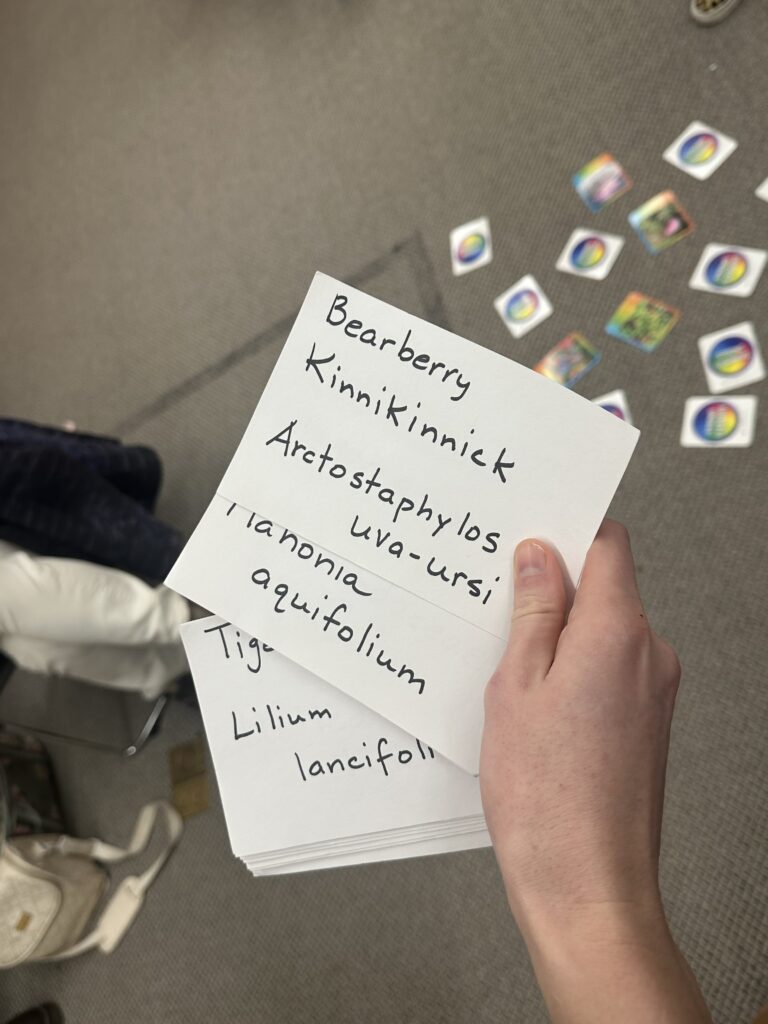
For our activity, we used cards with local Ktunaxa plant names and cards Judi created with the local name, Ktunaxa name and scientific name.


Next, find art supplies from around the school and thick branches. We used..

  1. Branches washed up on river banks that Judi collected for us prior to class.
  2. Hot glue
  3. Yarn
  4. Tissue paper
  5. Beads
  6. Pipe cleaners and more

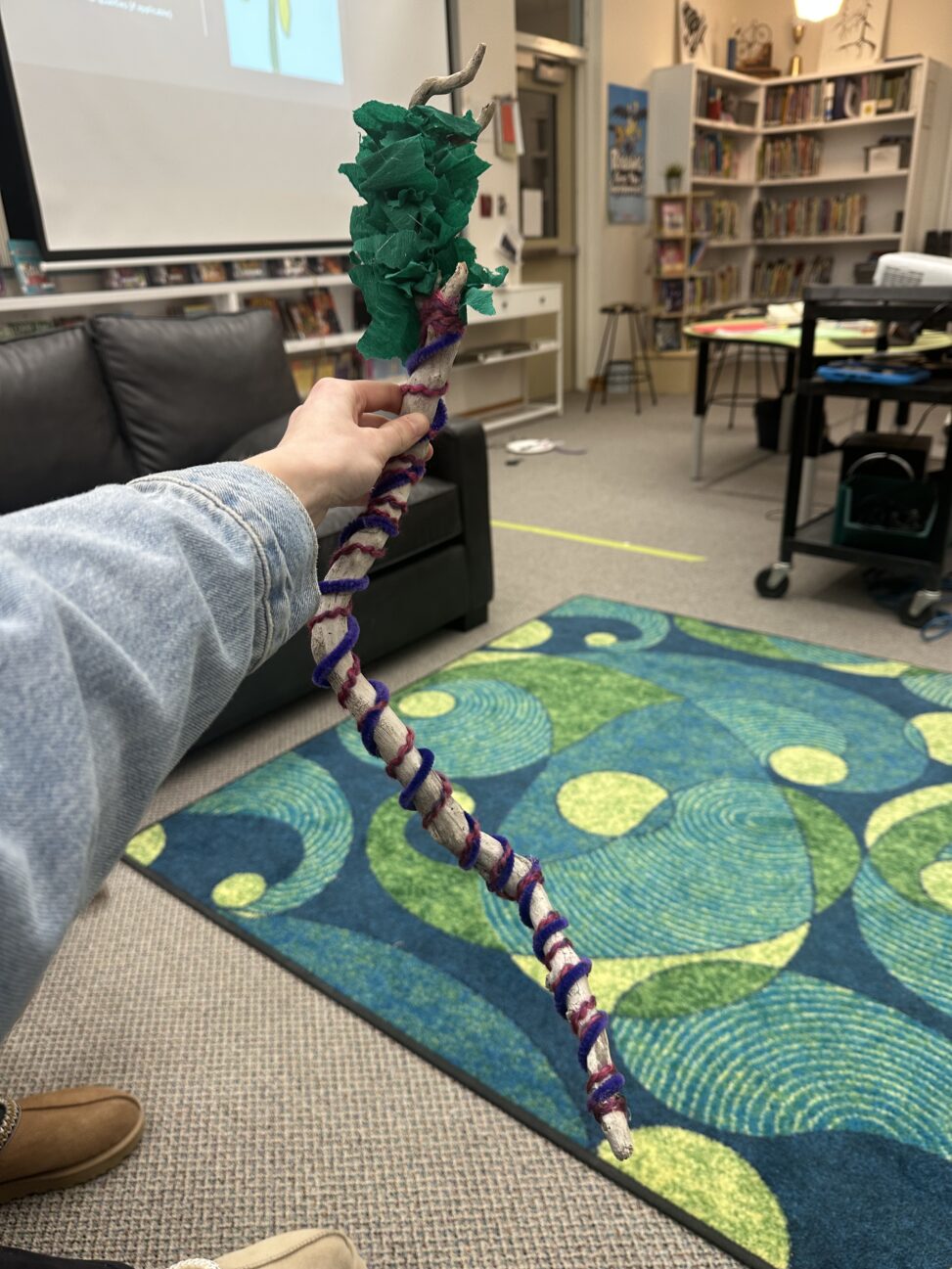
Then, explain to students that they will be creating newly discovered plants using the materials provided. Students will also create a scientific name, create a story of how they found this plant and imagine a way the plant will positively impact the community.


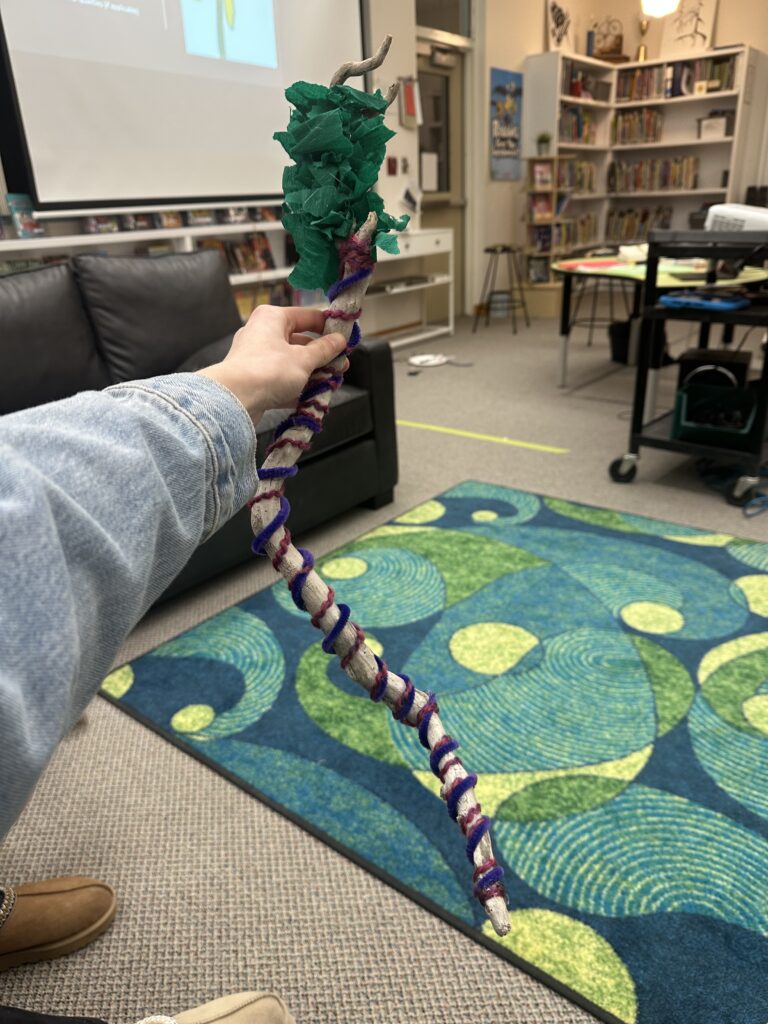
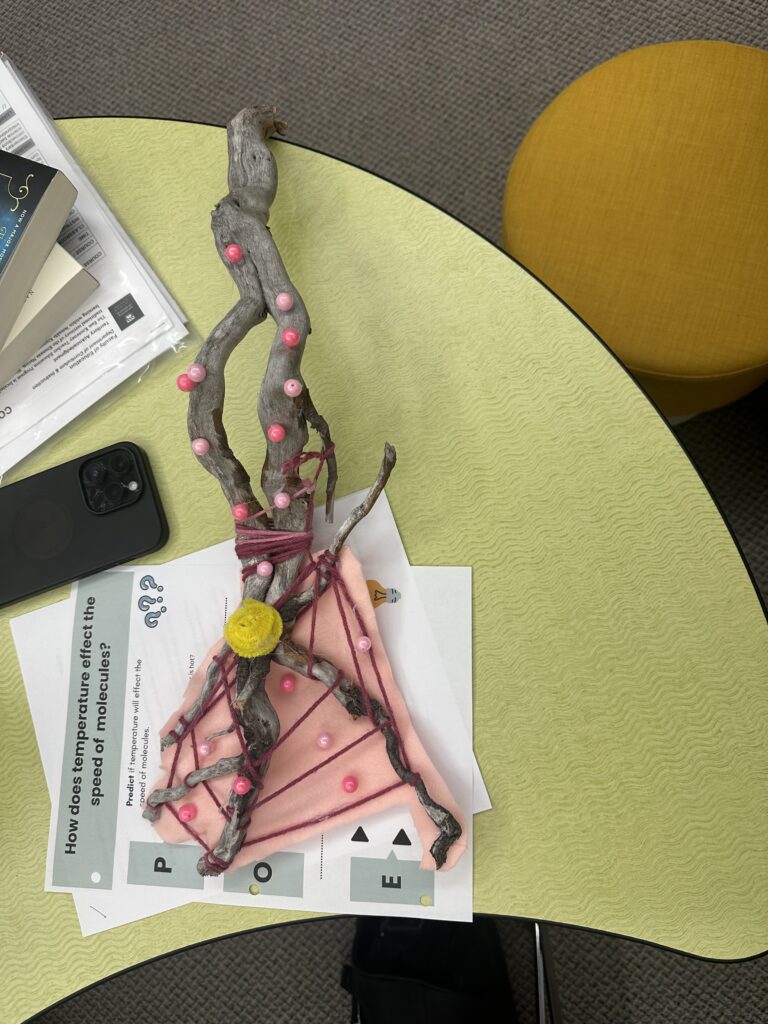
This plant is called Conversatious-enewis. I found it going on a walk on my property with my partner. Where we discovered that it sparked meaningful conversation between us. Its power is to give people the courage to have conversations in order to heal relationships. Created by Kenna Scory.


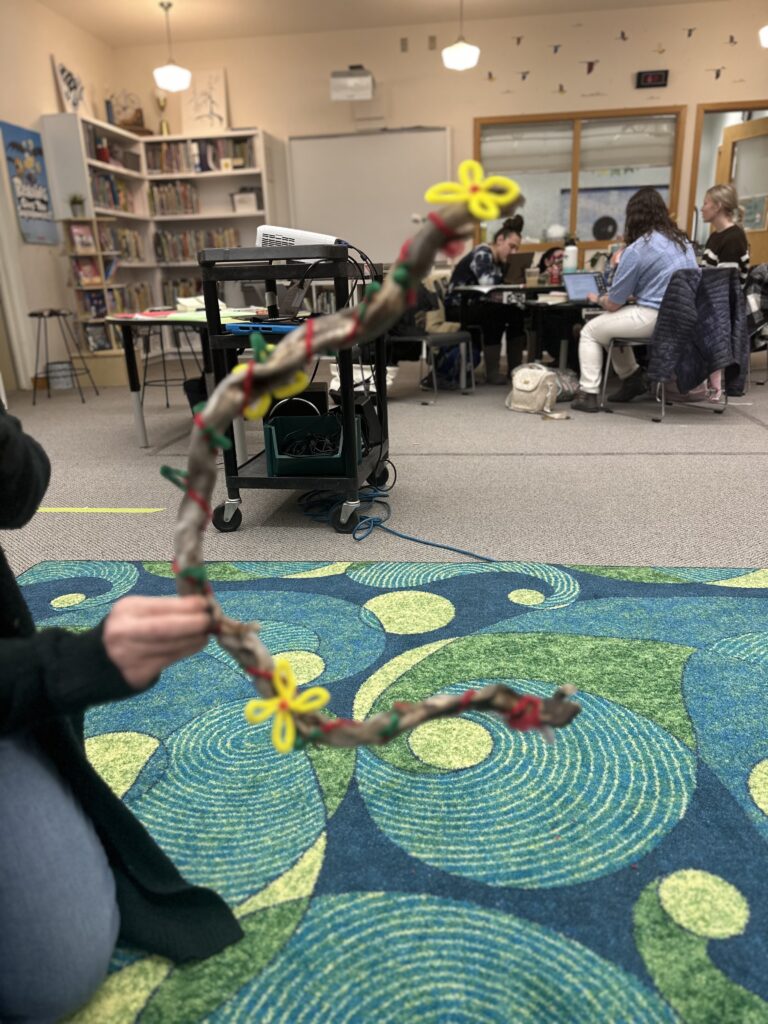
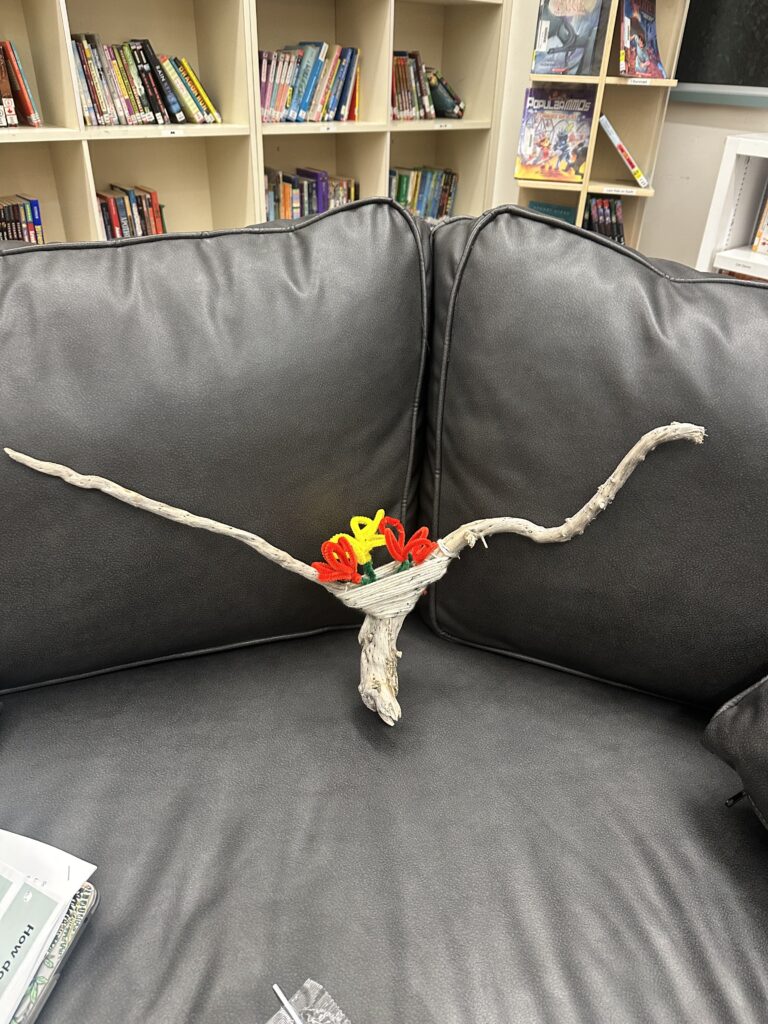
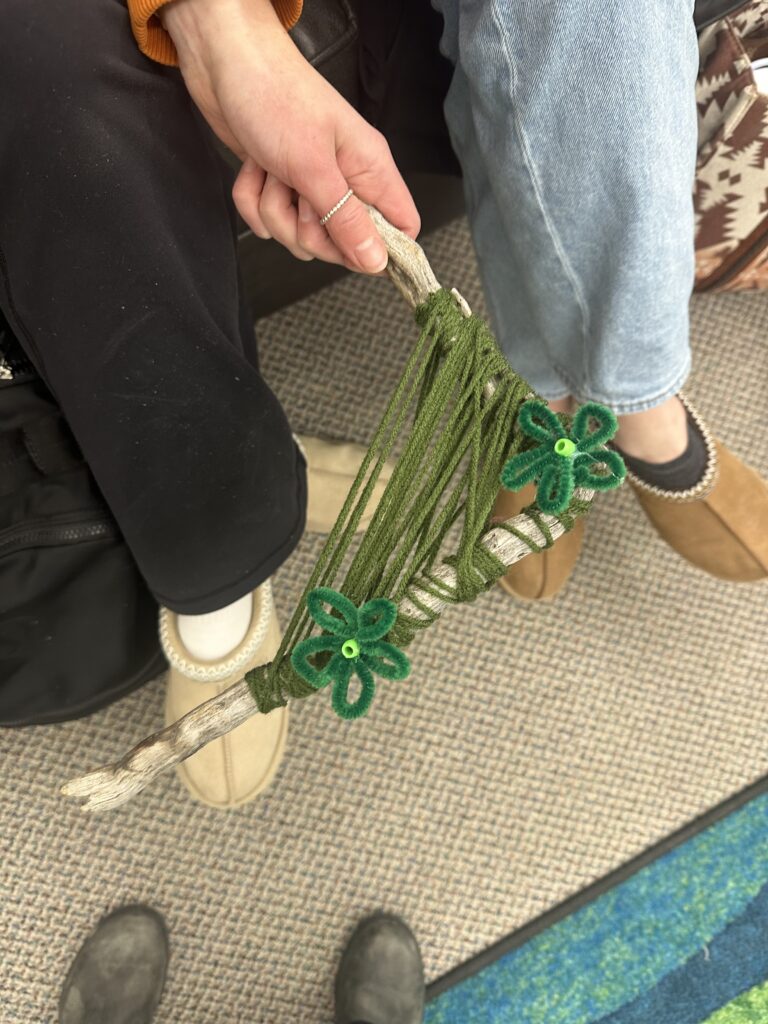
Some other class examples.

Created by Eva Sommerfeld and Ryan Anderson.


Created by Josie Mackie and Ryley Haynes.


I included this activity in my reflection because this activity made me realize that science can be creative. Growing up I never had the opportunity to create my own science. I remember copying scientists’ experiments and recording my data and hypothesis on a sheet to be graded. This activity helped me to think outside the box and create new experiences for my future students. I have the belief that science is a prescribed order of steps, and though that is still true, I realized it does not always have to be that way. I can be creative and make science cross-curricular with anything, like art!

AHA / Wonder Journal #1

Tree Cookies

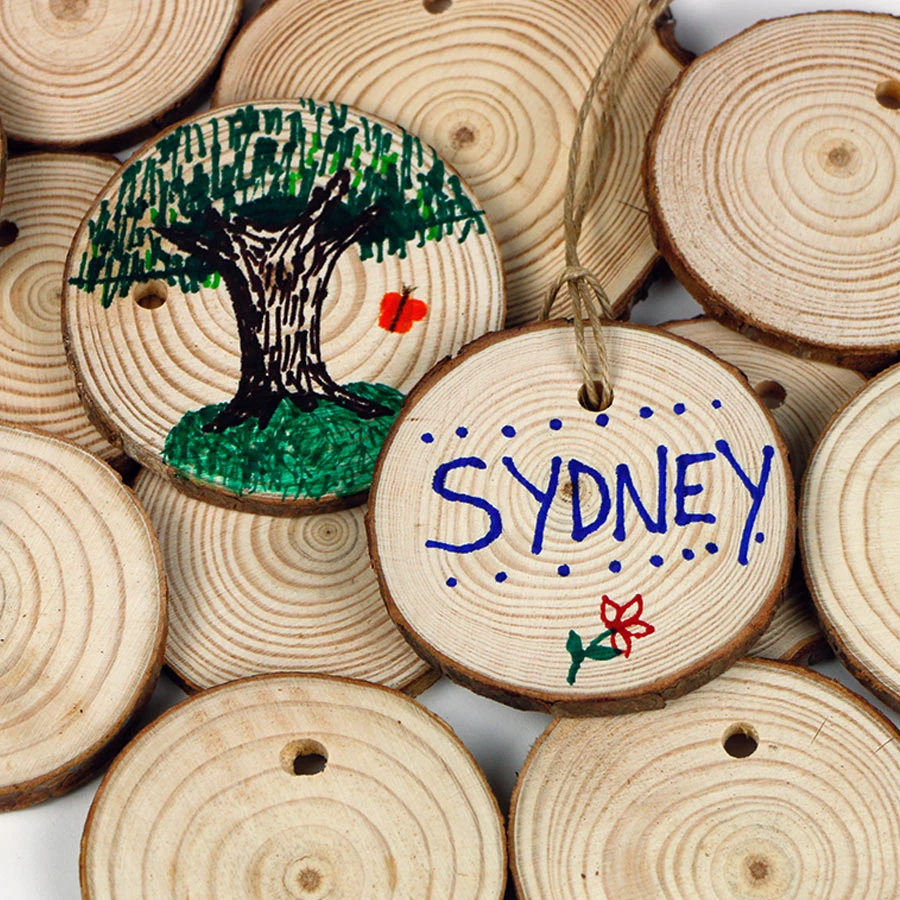
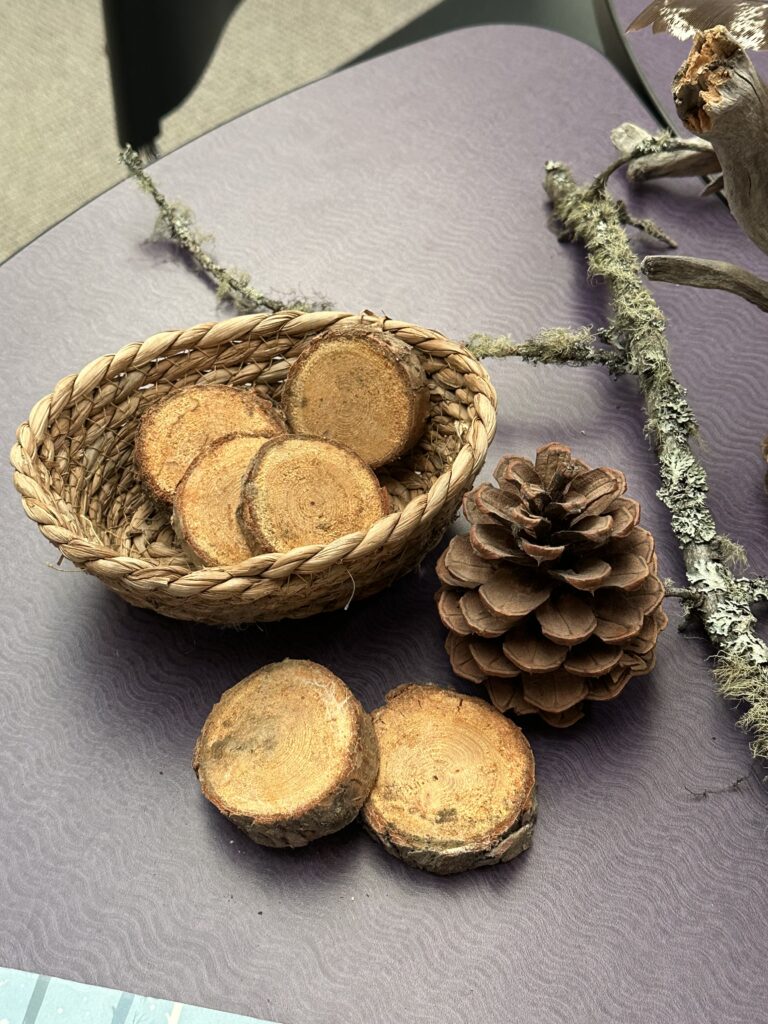
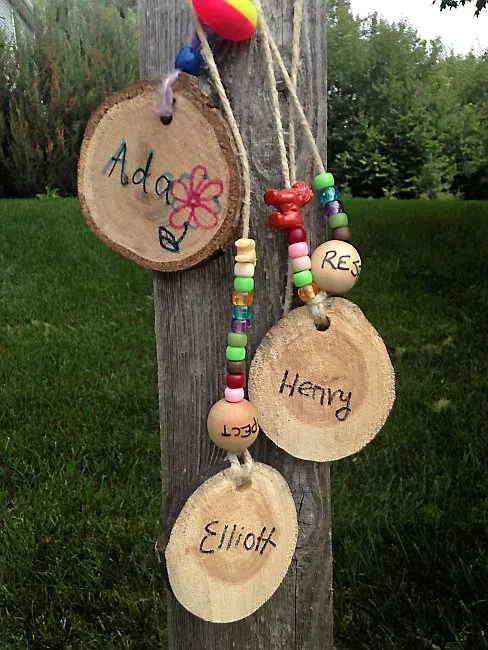
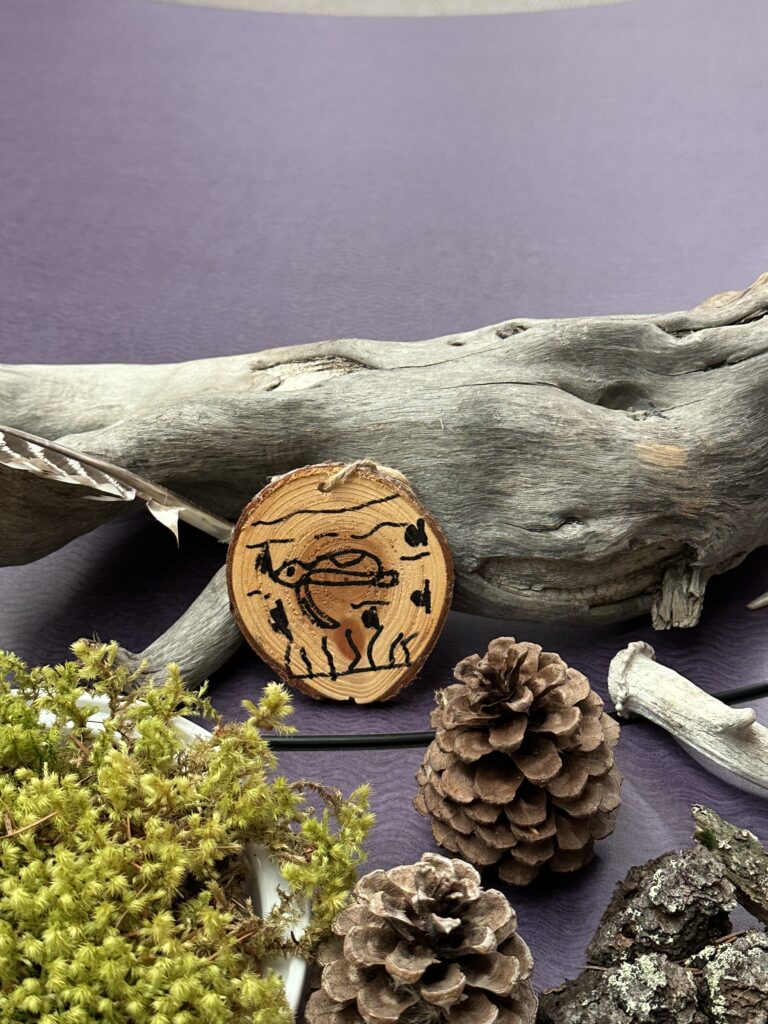
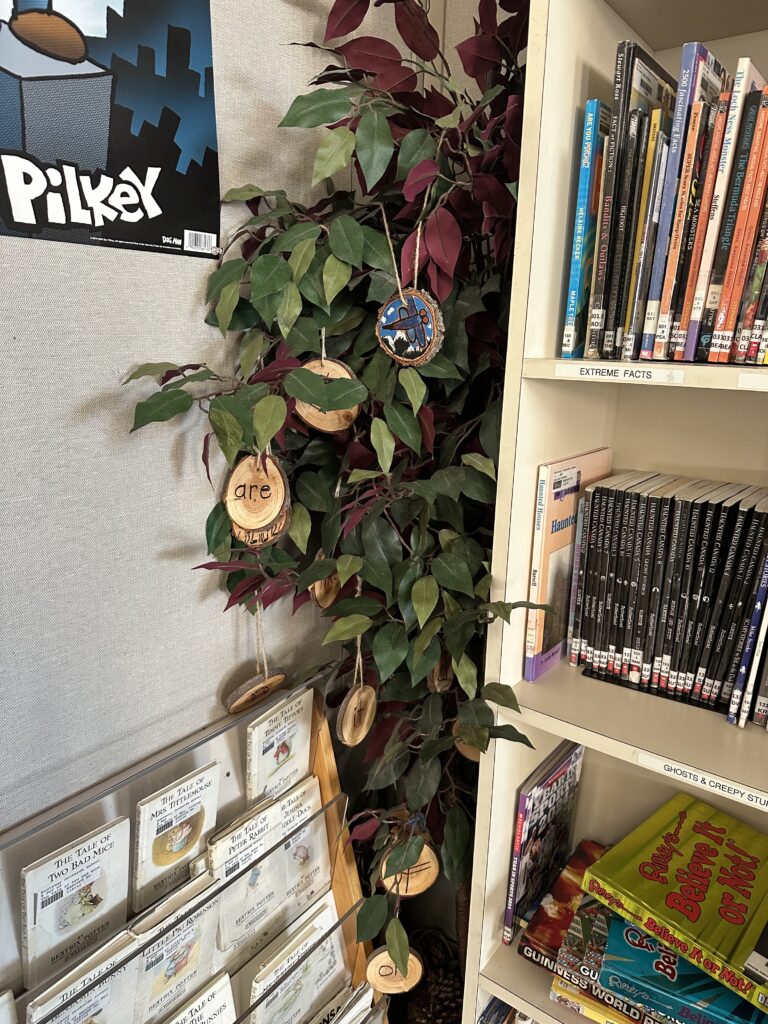
At the beginning of the course, my instructor gave each of us a small circular piece of wood (a piece of a small tree trunk) that had been cut. We call these tree cookies. Each student was asked to write their name on their tree cookie. Since then, our instructor has used the tree cookies to create groups, as a human barometer, and a tool to choose students to call upon.

What I enjoy about using tree cookies is how something so small can mean so much. Tree cookies are usually created from old Christmas tree trunks and repurposed into something new.

Rather than a piece of paper, a popsicle stick or a photo from a bad hair day to use in the classroom, students get a piece of the tree to not only call their own but also to connect with the land.

All grades in British Columbia discuss taking care of the planet. Tree cookies are a great example of recycling something old and finding a new purpose. Though some articles say “deforestation affects less than 0.02% of Canada’s forests each year” (Natural Resources Canada, 2016), we Cranbrookians know the real effects deforestation has on our communities, and it is important to highlight deforestation in classrooms.

What excited me the most is that tree cookies not only connect to the curriculum but also to the First Peoples Principles of Learning. Where tree cookies help us connect to the land, our community and the people who were here before us. Trees also take many years to grow, which reminds us of the patience and time we need to succeed.

I started with tree cookies for my AHA moments because I realized how authentically they bring the forest into the classroom. Tree cookies are also inexpensive and readily available for student teachers like me. Tree cookies hold a lot of meaning and are great metaphors for climate awareness, Indigenous education, and self-reflection, all of which pertain to the British Columbia curriculum in all grade levels.

Reader Note:

  • All images are hyperlinked for your access

Worldview Reflection

Teacher Identity

  • What Does it Mean to be ‘Effective’?
    • During my first practicum, my students created a binder for me. In the binder were pages where the students wrote advice. Some were very cute suggesting I make sure I have strong relationships with my students and some were silly like make sure to not start any fires. To be an effective teacher you must start with strong and meaningful relationships with students. From there an effective teacher is someone who believes in every students success and uses those relationships as the backbone to teaching.
  • What Characteristics Does an Effective Teacher Have?
    • A focus on making students feel seen, heard and valued.
    • Believes in mutual respect between staff and students.
    • Commitment to being a lifelong learner.
    • Hold students to high standards.
    • Communicates effectively.
    • Demonstrates professionalism and so much more…
  • What Kind of Teacher do I Want to Become?
    • My number 1 teacher inspiration is Miss Honey from Matilda. I love how her students think of her as the kindest teacher. Miss Honey’s students and classroom brought her joy and pride. I hope that when I have my classroom that even on the hard days and I can still go home thinking that my class is my joy and passion.
  • What Do I need to Learn to Become an Effective Teacher?
    • To become an effective teacher I need to demonstrate professionalism. In correlation to the UVIC Teacher competencies, specifically number 3 (Cultivate a culture of professionalism by demonstrating professional standards, including the professional Standards for BC Educators) because to be the most successful teacher for my students I must abide by and be familiar with the teaching standards set in place by my university and the BCTF (British Columbia Teachers Federations).
    • https://onlineacademiccommunity.uvic.ca/teachered/competencies-12/
  • What Are My Beliefs About Teaching?
    • My teaching philosophy is to ensure I have created a safe and welcoming environment where my students not only learn but also thrive. To achieve my philosophy it comes down to one simple thing, RELATIONSHIPS! That is why when I went into my practicum class last week, I grabbed a class list and spent time talking with my students 1-on-1.

Worldview

  • What is a Worldview?
    • A worldview is the ‘lens’ we use to see the world.
  • How Would I describe My Worldview?
    • One of my worldviews is that I believe family, culture and traditions are one of the earliest worldviews that shape who we are. My ethnocultural identity has taught me the importance of my family and traditions such as embracing my Ukrainian heritage. My socioeconomic and geopolitical worldview has taught me that I am very blessed to be a Ukrainian in Canada because my family in Ukraine does not have the freedom I have today. My spiritual beliefs have taught me to walk this life with grace, love, respect and gratitude for the path I am on. 
  • As a Teacher Why is it Important to be Aware of my Own Worldview, as well As Those of My Students and Community? And What Can I Do to Not Impede the Success of Diversity of Learners in My Classroom?
    • Tied back to my teaching philosophy where I explain my goal is to create a safe and welcoming environment for my students, which also requires me to model empathy and inclusion in my classroom and community. Every person in a school and community has differences in their worldviews and recognizing that my worldviews will be different from my students, my colleagues, the parents I work with, etc. will prevent me from wanting to change others or push my beliefs onto people who think and feel differently than I do. An Individual can stay true to their worldviews while also accepting and embracing other worldviews. Worldviews are not like pie; you don’t lose pieces of your worldviews for every worldview you’re exposed to. I believe that embracing every student’s worldview in the classroom, starting by modelling your own, is an impactful way to embrace diversity.
  • When Do I Consider It Necessary to Challenge the Western Worldview as it Impacts the K-12 System?
    • I feel it’s necessary to challenge Western ideologies on a daily basis as I prepare to become a teacher. When I lesson plan I try to think of ways to have my students out of their desks and outside, ways to remove memorization and regurgitation of facts, reduce the amount of individual and isolated work ect. I feel half my role in lesson planning is undoing what Western education has done to our community. In summary, I consider it necessary to challenge Western worldviews regularly to achieve my teaching philosophy.
  • What Aspects of the BC Curriculum Reinforce or Challenge a Western Worldview.
    • Including Indigenous education is one way to challenge Western worldviews. However, I believe the curriculum can still improve on integrating Indigenous education authenticlly. 

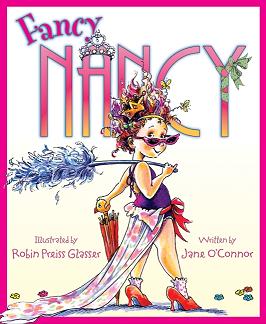
The One Book That Changed Everything!

Fancy Nancy is a popular children’s book series written by Jane O’Connor and illustrated by Robin Preiss Glasser. The series follows Nancy through stories about friendship, family, and fashion and it emphasizes Nancy’s imagination and her love of going against the grain. As a young reader, I was captivated by the bright shades of pink, purple, and blue, with glitter on the cover of the Fancy Nancy books. Robin Preiss Glasser did an incredible job illustrating the covers in a way that draws in young readers.

My favourite book in the series is the original Fancy Nancy. I loved that, no matter what the story was about, she always wore a tiara and pink.

Fancy Nancy became so successful that it was later adapted into a children’s television show.

I have linked a website called ‘Fancy Nancy Facts for Kids’ for more information about the series and author Jane O’Connor.

During reading time in elementary school, I was often the kid who pretended to read, hoping no one would ask me what I was reading . In high school, I relied on summaries and teacher notes to help me understand the novels we read in class.

Now, as an adult, not much has changed. I usually read about two books a year for pleasure during summer holidays and the winter break, and I choose books on kindle so I can use reading-assistance technologies. Reading takes most of my energy because of how much effort I must put in to understand what I am reading.

You can tell your students what kind of reader you are and what kind of reader you have been in the past, so they can see that it is not a stagnant condition.

as cited in Sometimes Reading is Hard by Robin Bright (2021) page 22

« Older posts

© 2026 Kenna’s Portfolio

Theme by Anders NorenUp ↑