
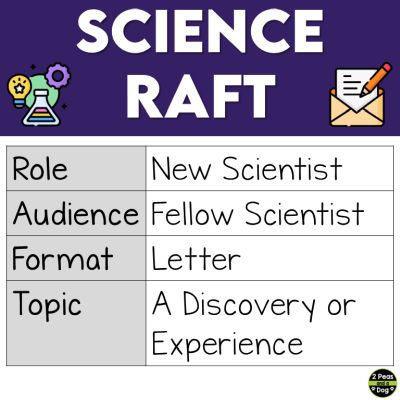
The RAFT strategy has 4 key components: Role, Audience, Format, and Topic. The RAFT strategy is a fun, creative way to engage students with content while helping them think about purpose and perspective in their writing!
What We Did!
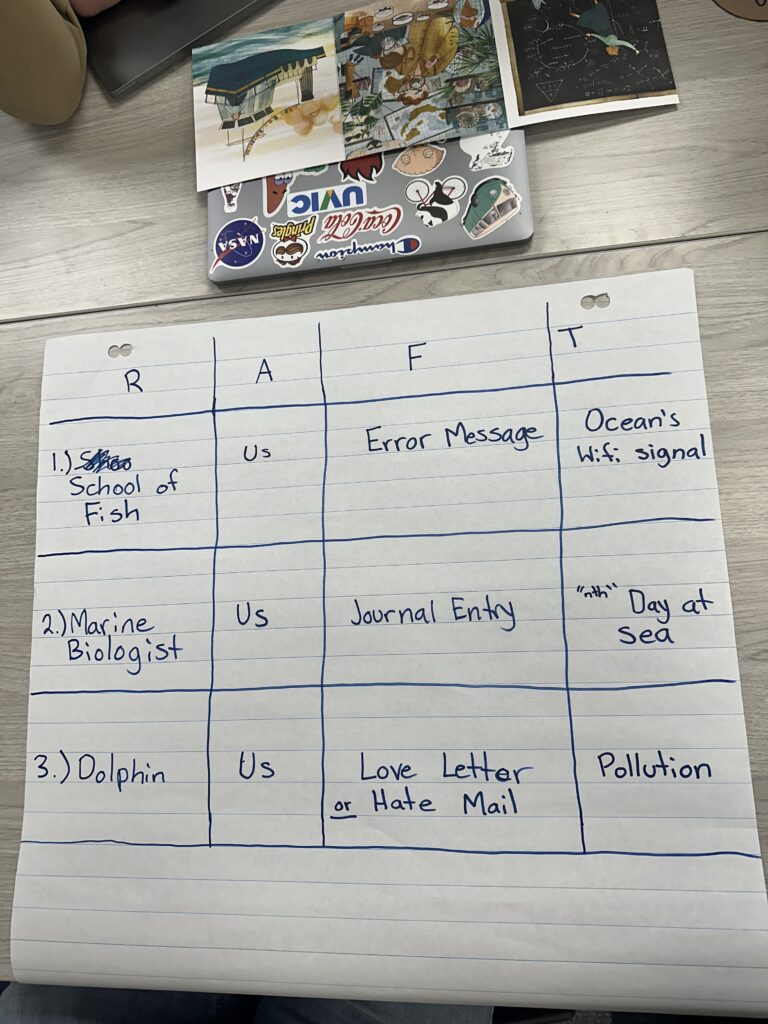
We started the lesson by splitting into small groups of four and finding a space to work. Each group received a piece of anchor chart paper, a marker, and the small picture book Ocean Speaks by Jess Keating and Katie Hickey. On their chart paper, groups created a RAFT organizer and labelled the four headers to match the science RAFT sheet we had modelled earlier. Then, using ideas from Ocean Sparks, each group brainstormed and recorded RAFT ideas connected to the story. My group came up with a school of fish, a marine biologist, and a dolphin for the role and continued generating ideas for the other spaces. See image below.
Then, groups swapped RAFT sheets and used the fate of a spinner to decide which topics we landed on. My group ended up with…
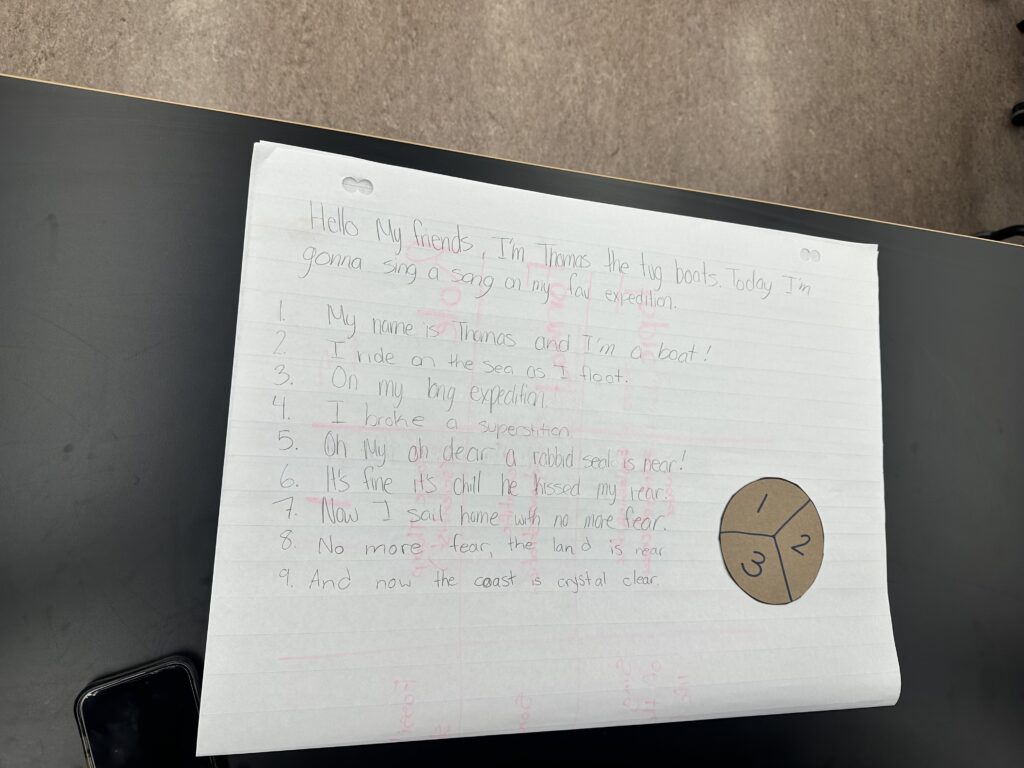
R: A boat
A: Us
F: A rap song
T: The best voyage
Then, we finished the lesson by sharing our creations.
Curriculum Connections
Because my practicum is in a grade 6 classroom, I have connected the RAFT strategy to the grade 6 British Columbia curriculum.
Grade 6 Science Competencies
- Communicate ideas, explanations, and processes in a variety of ways
- Express and reflect on personal, shared, or others’ experiences of place
- Generate and introduce new or refined ideas when problem solving
- Transfer and apply learning to new situations
- Demonstrate a sustained curiosity about a scientific topic or problem of personal interest
Grade 6 ELA Big Idea
- Language and text can be a source of creativity and joy.
Grade 6 ELA Competencies
- Select and use appropriate features, forms, and genres according to audience, purpose, and message
- Use writing and design processes to plan, develop, and create engaging and meaningful literary and informational texts for a variety of purposes and audiences
- Recognize and appreciate how different features, forms, and genres of texts reflect various purposes, audiences, and messages
- Respond to text in personal, creative, and critical ways
BC Curriculum- https://curriculum.gov.bc.ca/curriculum/english-language-arts/6/core
Why I Chose to Include R.A.F.T.
I chose to include the R.A.F.T. strategy in my reflection because it was my first time working with the strategy, and I really enjoyed the activity. I found the activity fun and engaging, and something I would do with my own students. I love how the activity created space for students to be creative while also engaging with content. The R.A.F.T strategy is versatile and could have many purposes in the classroom. I am excited to bring this activity into my practicum class in the next few months!
Provide Feedback
You must be logged in to post a comment.